Details
- Object type
painting
- Title
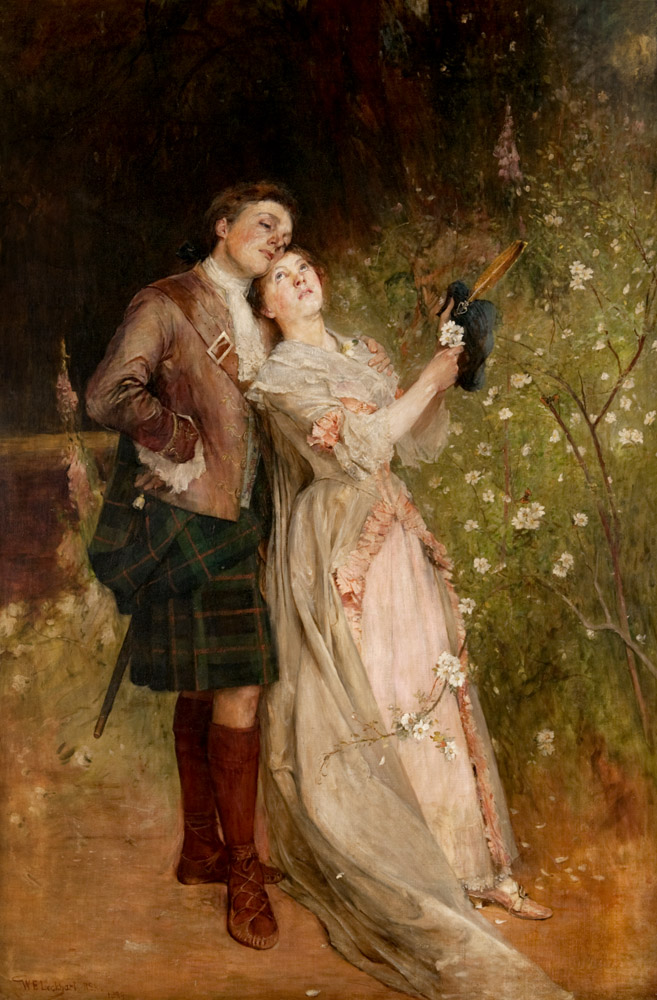
The White Cockade
- Artist/Maker
William Ewart Lockhart artist
- Culture/School
Scottish
- Date
1899
- Materials
oil on canvas
- Dimensions
framed: 2240 x 1634 x 133 mm;unframed: 1829 mm x 1219 mm
- Description
-
This sentimental painting by William Ewart Lockhart depicts an episode from the Jacobite Rebellion of 1745. Standing in a garden setting, a young man in Highland dress is having a white briar rose, emblem of the Jacobite Cause, fixed to his bonnet by his sweetheart. The girl in the painting wears a robe à la française or ‘sack-back’ gown. This more loose-fitting style of dress was fashionable in the 1730s and was made from five or six panels of fabric pleated into two box pleats at the centre back of the neck band.
Fitted over a hoop of various sizes, the gown could be worn closed in the front or open to reveal a matching petticoat. This relaxed style lent itself well to lighter fabrics such as Indian cotton and silk and was dyed in lighter pastel shades for a graceful appearance. Sleeves were bell- or trumpet-shaped and caught up at the elbow to show the frilled or lace-trimmed sleeves of the shift (chemise) worn underneath. The dress in the portrait is painted in a pretty pale pink and left open to reveal a matching petticoat. The robe is finished with romantic ruffles and a modest neckerchief is draped around her shoulders to conceal her chest. The Watteau pleats drape behind her creating a highly romantic full train.
The Jacobite soldier wears a short brown (probably woollen) jacket over a high neck, white linen shirt with decorative frills around the neck and cuffs. The jacket is cut in a short style to fit over the belted plaid, or féileadh-mór, which is shown in red and green woven tartan. He wears red hose and brogan tionndaidh (early form of brogue shoes) that would have been mostly made from deerskin.
The Jacobite army did not prescribe to a set uniform except in the case of a few units. The majority of the tartan that the Jacobite’s wore were not clan tartans, although families and clan members may have worn similar patterns. This would more likely have been the result of using the same local weaver who would only have had knowledge of so many variations. The Jacobite’s chose brightly coloured tartans that were created using imported dyes rather than native dyes made from materials that were available in the Highlands that may not have been as strong in colour.
Due to the lack of identifiable uniform, distinguishing marks were necessary to determine who was a Jacobite soldier and who was not. The white cockade became a universal emblem of the Jacobite cause. The white cockade was not a Stewart emblem and so historians have attributed the white cockade to the influence of Louis XIV’s army in France. The French army was the only one to use white cockades as a uniform feature. However, it was Louis XIV who decreed that the national colour of France would be white. As Bonnie Prince Charlie and the Jacobite’s had a strong connection with France, it could be argued that the white cockade worn by the Jacobite rebels correlated with this emblem of France.
Worn on the bonnet, the white cockade was the distinguishing badge between Jacobite and Hanoverian. In most of the trials after the defeat at Culloden, one of the most damning evidences against a prisoner was the sworn testimony that he had been seen wearing a white cockade.
Painted in 1899, 154 years after the Battle of Culloden, this romanticised depiction of the Jacobite wars was typical of the Victorian era. Sentimental scenes of the Jacobite rebellion and wearing of tartan proved a popular subject for many Victorian painters. With the rise of industrialisation in Scotland, new generations were nostalgic for a more traditional era that to them embodied values of chivalry, heroism and loyalty.
- Credit Line/Donor
Gifted by the executors of Mrs Mary Lockhart, 1934
- ID Number
1879
- Location
Kelvingrove Scottish Identity