Details
- Object type
print
- Title
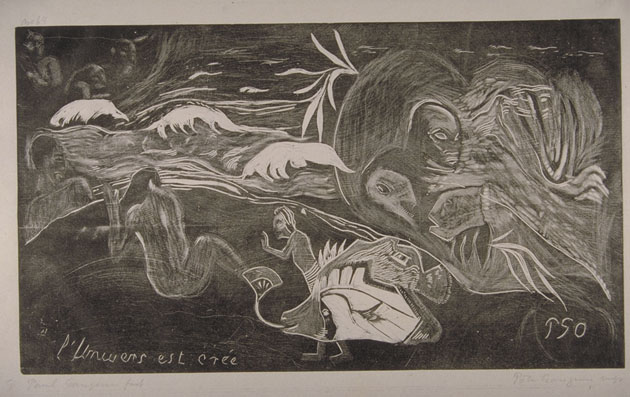
L'Univers est créé
- Artist/Maker
- Culture/School
French
- Place Associated
France
- Date
1893-4
- Materials
black ink, paper
- Dimensions
image: 205 mm x 353 mm
- Description
-
During his time living on the French Polynesian island of Tahiti, Gauguin was interested in exploring Tahitian beliefs. He sought to depict the island’s spirituality through his paintings, as well as the woodcuts he created immediately after returning to France in 1893. His suite of prints made to accompany ‘Noa Noa’ (see below) are infused with an eerie, nocturnal otherworldliness. This print features a number of strange and unexpected additions, such as the large, floating fish in the foreground, and the mask-like head, which is reminiscent of the spectre seen in ‘manao tupapau’ (also in Glasgow Museums’ collection, PR.), as well as his ethnographically-inspired carved objects (such as ‘Oviri’, Musée d’Orsay, Paris). This print is possibly the most abstract of the ‘Noa Noa’ suite, and is the only one without a Tahitian name. Gauguin instead gave it a French title, which means ‘the universe is created’.
Between 1891-1893 Paul Gauguin spent his first stretch of time on Tahiti. He fantasised about finding a ‘primitive’ life, different from the urban sprawl of Paris he was used to. What he actually encountered was a life much more modern than he’d anticipated. Regular shipments of mail, newspapers and art supplies kept him in touch with the outside world, and he surrounded himself with Europeans. Nevertheless, there Gauguin was able to live out some of deepest erotic fantasies, in a society where sexual practice was seemingly more liberal than in his native France, and he could take advantage of his privileged position as white, European man.
In Autumn 1893, within months of returning to Paris, Gauguin began recording his experiences of the island, with the intention of making the paintings he’d created on the island more understandable to a European audience. The resulting book, ‘Noa Noa’ (meaning ‘fragrance (of humans)’ in the local language) describes his life on Tahiti as he wished others to see it, writing shockingly of the young teenagers he had sex with, his rape fantasies, as well as his sexual objectification of both male and female islanders. The book centred largely on his erotic experiences with a 13-year old child who became the 43-year-old’s ‘vahine’- a Tahitian word Gauguin used to mean both ‘whore’ and ‘wife’.
Around the time he was writing ‘Noa Noa’, Gauguin produced a set of woodcut prints to accompany the book. These were completed by spring, 1894. The ten prints produced for ‘Noa Noa’ can be considered Gauguin’s finest works on paper, modernist prints to inspire later generations of artists. The woodcuts, composed of several blocks of boxwood joined together, showcase myriad techniques, from ultra-fine scratches, to deep gouges in the wood, and were created using carpentry tools rather than traditional engraver’s tools. Gauguin experimented with the printing process, and rather than altering the block itself, varied the application of ink, sometimes deliberately double-printing, and using multiple colours.
Gauguin became involved in the printing himself, producing a handful of impressions from each block. In 1894, the artist collaborated with printer Louis Roy to create a commercial edition of around 25-30 sets of the prints. The prints in Glasgow Museums’ collection were printed much later, in 1921. Pola Gauguin, the artist’s youngest child, printed 100 impressions from each block. They are printed in black ink, and create a faithful rendering of his father’s work. Glasgow’s collection contains an incomplete set of ‘Noa Noa’ prints, without ‘Te Foruru’ and ‘Te Atua’. All of the prints are number 64 in the series of 100.
- Credit Line/Donor
Acquired 1924
- ID Number
PR.1924.31.f
- Location
In storage