Alternate images
Details
- Object type
drawing; watercolour
- Title
Part Seen, Imagined Part
- Artist/Maker
Charles Rennie Mackintosh artist
- Culture/School
Glasgow Style
- Place Associated
Scotland, Glasgow (place associated)
- Date
April 1896
- Materials
watercolour, pencil, gold pigment, tracing paper
- Dimensions
unframed: 390 mm x 195 mm
- Description
-
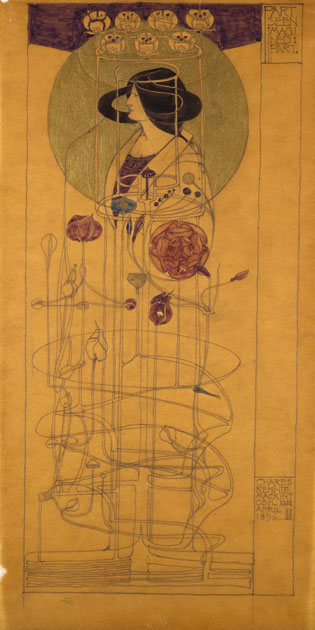
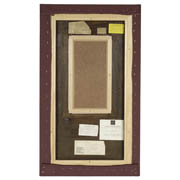
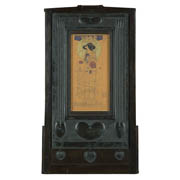
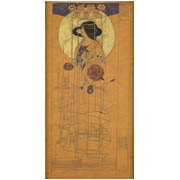
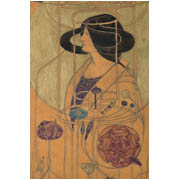
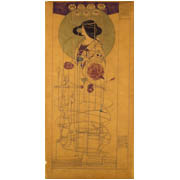
Pencil and watercolour drawing with gold pigment on tracing paper titled Part Seen, Imagined Part, by Charles Rennie Mackintosh. Signed and dated in pencil, April 1896.
This enigmatic female with her whiplash hair and kimono gown references the influence of Japanese art and the contemporary ideals of Art Nouveau. The gold nimbus framing her head evokes religious imagery. The female’s figure emerges from the ground from a natural tangle of plant stems. She is only partly visible; colour is added as her upper body takes form and her head is framed with a stylised linear structure topped with flowers. The pencil line on this drawing is not a sketch, it is one continuous traced line indicating that this is Mackintosh working up an idea made over another work. He exhibited this drawing at the 5th Exhibition of the Arts and Crafts Society in London in 1896.
Possibly Part Seen is a tracing Mackintosh made over his design drawing for the stencilled decoration scheme for the Luncheon Room at Miss Cranston’s Buchannan Street Tearooms, or an early drawing that inspired it. In that dining space one long wall featured a statuesque procession of these women, rising from the top of the dado panel to the ceiling, where they would have towered over diners. They stood within a flattened landscape of strange plant forms, their repetitive presence punctuated by trees, behind which large pairs of eyes of unknown origin spookily stared out. This mural was one of three Mackintosh undertook between 1896 and 1897 for Miss Cranston, his first interior commission for the Glasgow tearoom entrepreneur. She would become one of his most important patrons.
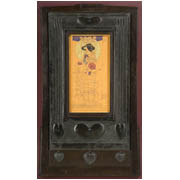
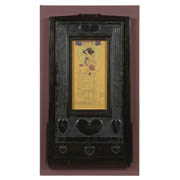
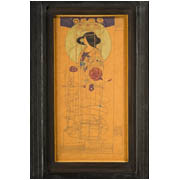
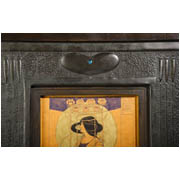
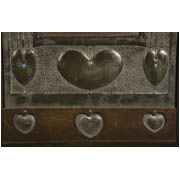
Part Seen sits within a bespoke stained wood frame decorated with repoussé and chased metalwork inset with glass cabochons (E.1939.55.a). The frame was designed and probably made by Talwin Morris sometime between 1896-1899. Morris, the artistic director for Glasgow publisher’s Blackie & Son, and his wife Alice came to own Mackintosh’s drawing, along with a number of early artworks by ‘The Four’ - Mackintosh, the sisters Margaret and Frances Macdonald, and James Herbert McNair. The Studio magazine published two features Some Glasgow Designers in 1897 profiling ‘The Four’s’ work. Author Gleeson White profiled Morris as the fifth member of this innovative group. Mackintosh and Morris were good friends and Morris’s work shares many of the defining principles of early Glasgow Style. A letter (GML.2018.1.12) written by Alice Talwin Morris in 1939 when she donated this work and others to our collection, mentions Mackintosh’s many visits to their home and the late-night artistic conversations they had there. However, we do not know if the couple purchased this drawing from Mackintosh or received it as a gift.
- Credit Line/Donor
Presented by Mrs Alice Talwin Morris, 1939
- ID Number
PR.1977.13.aq
- Location
In storage