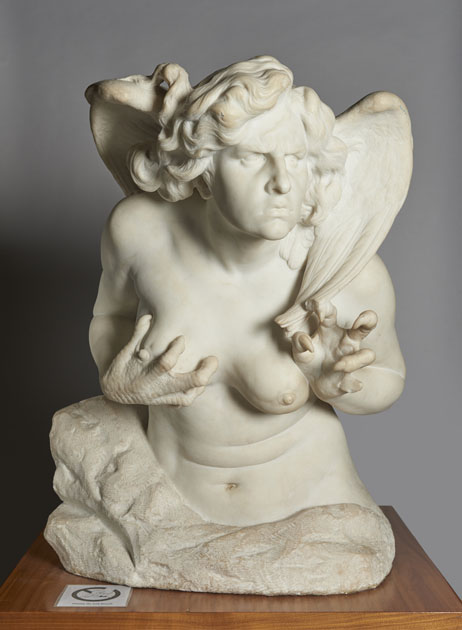
Details
- Object type
sculpture
- Title
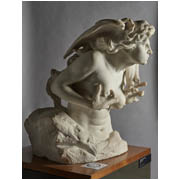
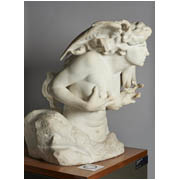
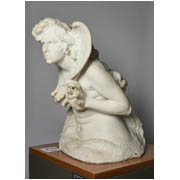
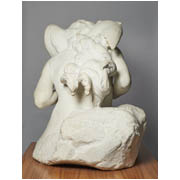
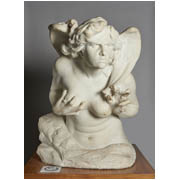
The Harpy Celaeno
- Artist/Maker
Mary Pownall maker
- Culture/School
British
- Place Associated
Italy, Rome (place made)
- Date
1902
- Materials
marble
- Dimensions
overall: 890 mm
- Description
-
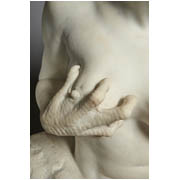
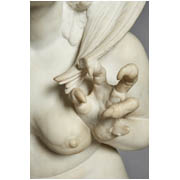
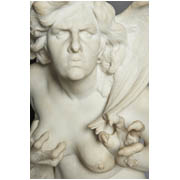
Mary Pownall’s sculpture The Harpy Celaeno is full of energy and menace with its intense, piercing stare and heavy frown. In Greco-Roman mythology harpies were half-human, half-bird personifications of storm winds. In the famous Latin poem The Aeneid, Virgil describes them as ‘Bird-bodied, girl-faced things […], their hands are talons, their faces haggard with hunger insatiable’. In Pownall’s sculpture, Celaeno appears as if emerging from the clouds, wings sprouting from her neck among wild, curling hair that snakes down her back. Her hands are scaly and claw-like, with sharp talons. Her right talon clutches her right breast, appearing to pierce the skin. Her nipples are erect, implying arousal at this violence. The white marble has been very cleverly chosen and carved, its veins suggesting actual flesh. The life-like nature of the figure is increased by the inclusion of creases on the neck, realistic folds of flesh around the stomach and stretchmark-like lines around the hips.
Celaeno, literally means ‘the dark one’. According to Virgil, the Trojan hero Aeneas encounters Celaeno at Strophades, a group of small Greek islands, on which he lands after a storm. Aeneas and his crew kill animals on the island for food, angering the harpies, the leader of whom is Celaeno. She makes prophecies about the epic journey Aeneas is about to make, issuing a curse: the Trojans will not find their home until hunger has made them eat even their very plates. In Pownall’s sculpture, Celaeno’s deep set eyes appear to be not only staring at us but looking into the future, the violent way she clutches her breast suggesting not only anger, but the great suffering and hunger to come.
This sculpture not only represents a powerful female figure from mythology, but was made by a woman artist who lived and worked at a time when to be a woman meant it was much harder to get an art education, access a studio and art materials, be selected for major exhibitions and find representation from an art dealer. The daughter of a Manchester silk manufacturer, born near Leigh in Lancashire, Pownall studied in Frankfurt, Paris (where she was a pupil of the famous sculptor Rodin from 1897 to 1898) and Rome. Pownall married around 1902/3. The societal expectation would have been that she would have given up her career at that time to become a wife and mother. However, she continued to work and exhibit internationally, significantly using her maiden, not married, name. Building up a considerable reputation, she became President of the Society of Women Artists. It seems very appropriate that the model for the forceful Celaeno was the artist herself. She wrote in her autobiography: ‘I found it impossible to find a model that would give me the facial expression I wanted, hunt as I would. At last I was obliged to use my own face, holding a mirror in my left hand and modelling with my right’.
The sculpture was made and exhibited in Rome in 1902 and was also shown at the Paris Salon in 1905. It was bequeathed to Glasgow Museums in 1944, after the artist’s death, along with another sculpture by her called The Wave. Both were gifted by her husband Alfred Bromet, who wanted to continue her legacy and ensure her representation in public collections in the UK.
- Credit Line/Donor
Bequeathed by Mr Alfred Bromet, the artist's husband, per Messrs Sedgwick, Turner, Sworder and Wilson, 1944
- ID Number
S.235
- Location
Kelvingrove Expression