Details
- Object type
painting
- Title
The Virgin and Child
- Artist/Maker
Giovanni Bellini artist
- Culture/School
Italian
- Place Associated
Venice; Italy
- Date
circa 1480-1485
- Materials
tempera and oil on panel
- Dimensions
framed: 985 mm x 829 mm x 134 mm; unframed: 622 mm x 464 mm
- Description
-
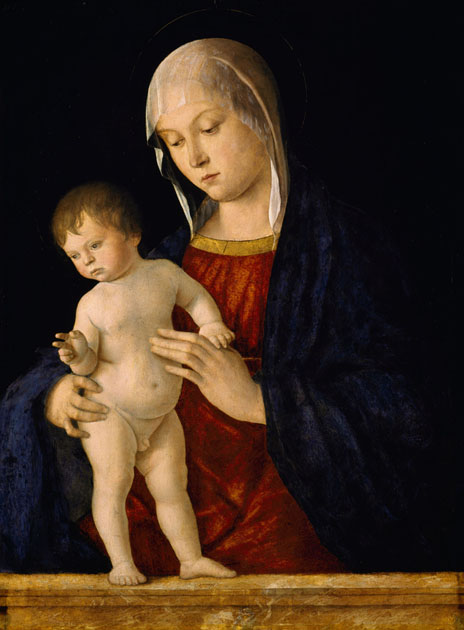
Characteristic of the many Virgin and Child compositions of Bellini’s mid-career is the portrayal of the Virgin in half length behind a marble parapet, which serves both as a firm base for the triangular figure composition, and as a way of separating the sacred space of the figures from the real world of the viewer. Unusual in this instance is the fact that the figures focus their attention beyond the picture to the lower left, almost as if the Child was blessing an unseen kneeling donor. The painter has used a dark, neutral background, instead of a curtain, landscape or sky. X-radiography has shown the dark background to be original, and Bellini employs it in several of his other devotional half-lengths, including the important, probably closely contemporary, ‘Virgin and Child with Two Female Saints’ (today in the Gallerie dell’Accademia, Venice).
When in the collection of John Graham Gilbert, this picture carried a strange attribution to Carlo Dolci, and it is still recorded as such in Glasgow Museums’ catalogue of 1882. Although the relationship with Bellini was recognized by 1895, the autograph status of the picture has subsequently not always been accepted: Gronau (1930) and Dussler (1949) regarded it as a workshop variant of a lost prototype. Heinemann (1962) attributed it to Bellini’s follower Francesco Bissolo; and Robertson (1968) and Goffen (1989) silently omitted it from their monographs. These negative judgements have probably, however, been unduly influenced by the picture’s imperfect state of preservation, as the quality of the relatively undamaged areas, and of the painter’s hatched underdrawing, is high. This underdrawing is visible to the naked eye in the areas of the flesh where the paint has worn thin, but it is more fully visible in the infrared reflectogram, which also reveals a number of slight pentimenti, as in the positioning of the fingers of the Child’s left hand and of the Virgin’s right hand. The tender expressiveness of the faces of both figures likewise justifies the acceptance of the work as an autograph Bellini by Berenson (1957), Tempestini (1992, 1999), and others. Suggested datings range from c.1475 and c.1490,4 and the picture clearly does reflect an interest in the volumetric style of Antonello da Messina, who visited Venice in 1475–6. But as proposed by Tempestini, the date can be narrowed down most plausibly to the early 1480s, to a phase immediately following Bellini’s great San Giobbe altarpiece (today at the Accademia, Venice), datable to c.1478–80. As in the altarpiece, the physiognomies are more spherical and less elongated than in Bellini’s works of the earlier 1470s; and while the painter was by this date experimenting with the new medium of oil, he retained a taste for silhouetted, rhythmically undulating outlines. By contrast, although the pose of the standing Child is very similar to that of his counterpart in the Frari Triptych of 1488 (today at the Santa Maria Gloriosa dei Frari, Venice), by that date Bellini’s forms had become much more softly rounded. In their analysis of the evolution of the painter’s underdrawings, Poldi and Villa (2006) concur with a dating to the early 1480s. Gronau (1930) mentions a weaker version of the composition in the Sedelmeyer sale in Paris in 1907 (no. 112, with an attribution to Cima da Conegliano). This may be identical to one on the London art market in 1967, in which the Virgin and Child have been given a landscape background.
- Credit Line/Donor
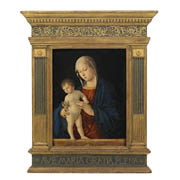
Bequeathed by Jane Graham Gilbert, 1877. Reframing of this painting was made possible by generous funding from the Friends of Glasgow Museums, 2011.
- ID Number
575
- Location
Out on Loan