Details
- Object type
screen
- Artist/Maker
John A Fetter maker (silversmith)
Jessie Marion King maker (drawing)
George Logan maker
Wylie & Lochhead Ltd maker
- Culture/School
Glasgow Style
- Place Associated
Scotland, Glasgow
- Date
1901-1902
- Materials
satin walnut, silver, mother of pearl, turquoise, red amethyst, white stone, leather, metal, glass, ink, watercolour, vellum
- Dimensions
overall: 1721 x 1372 mm
- Description
-
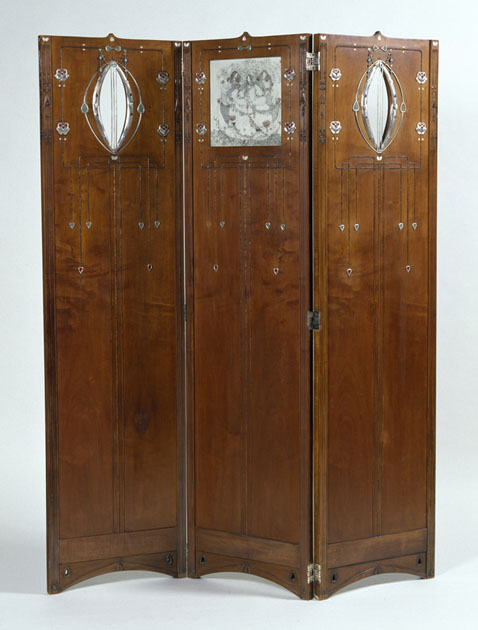
Folding screen, 1901–02, designed by George Logan, made by Wylie & Lochhead, Glasgow, silversmith John A. Fetter, drawing: The Princesses of the Red Rose, by Jessie Marion King. Satin walnut, silver, mother of pearl, turquoise, red amethyst, white stone, leather, metal, glass, ink, watercolour and vellum.
Folding screens were used for a variety of purposes in the homes of the middle and upper classes in the 19th century. They could be positioned to create private spaces within larger rooms or provide a discreet space behind which a person could dress or undress without being observed. However, this screen, design by George Logan for furniture makers Wylie & Lochhead, contains two eye-level oval cut outs, each oval teasingly barred by three silver vertical rods. As a result, his design contradicts the traditional function of a screen, because his screen can be partially seen through.
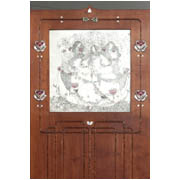
The focal point of the folding screen is an ink and watercolour drawing by Jessie Marion King entitled The Princess of the Red Rose. The red rose, one of the key recurring motifs employed by artists and designers of the Glasgow Style, is also a traditional symbol of passion, desire and voluptuous beauty. Therefore perhaps with intentional symbolism Logan has positioned the drawing of the only panel of the screen which provides complete concealment of the user.
The adornment of the three princesses in the drawing is carried through to that of the screen itself. At head height the silver ovals are flanked by painted red leather and silver roses and tiny mother of pearl drops, echoing the faces of the princesses. The screen has its own garlands in the form of silver chains strewn with pearls, turquoise and small silver hearts that hang above the cut-out ovals, and, more subtly, at the upper edge of each panel, delicately carved into the wood.
The weightlessness of the decoration on this upper half of the screen is soberly balances by the simple lines of the lower half’s wooden surface which visually weights the screen to the floor. The finished result is an elegant and luxurious piece of furniture, innovative in design for its time.
- ID Number
E.1986.52
- Location
In storage