Details
- Object type
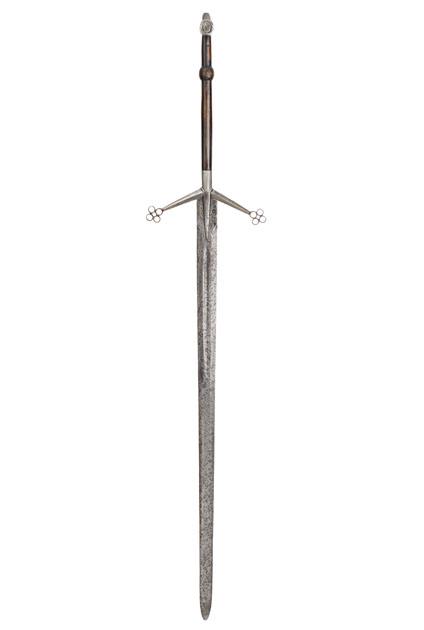
two-handed sword; claidheamh da laimh; claymore
- Place Associated
Scotland (hilt), Germany (blade), (place of manufacture)
- Date
late 16th century
- Materials
steel, wood
- Dimensions
overall: 1900 x 520 x 300 mm
- Description
-
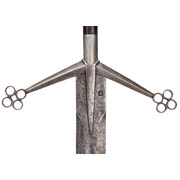
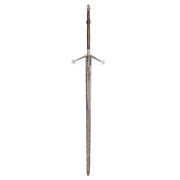
This type of sword is often referred to as a claymore. Arms and armour scholars have shown that this word was used from 1678 as a battlecry. A letter from this year describes men from ‘great host of Highlanders’ attacking a Lowlander and ‘having their broadswords drawn, cryed “claymore”, and made at him’. The Jacobite officer Lord George Murray wrote in his diary of an incident in the rebellion of 1745: ‘I immediately drew my sword, and cried CLAYMORE!’ From 1715 the word was used for the basket-hilted sword. A description of Highlanders from this year mentions ‘fourty or fifty stately fellows’ each with ‘a sturdy claymore by his side’. In Scots and English this fearsome weapon was referred to as a two-handed sword.
A letter of 1595 from a Highland chief, Lachlan MacLean of Duart, stated that ‘we will not want our two-handed swords and armour of mail to be used if battle be offered to us’. A royal statute of 1608 tried to restrict what Highlanders could use: ‘they shall forbear wearing any kind of armour (specially guns, bows, and two-handed swords) except only one-handed swords and targes’. By 1679 ‘ane two handed sword’ was listed with other weapons confiscated from the MacLeans in Mull.
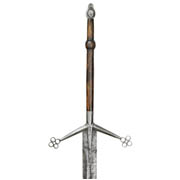
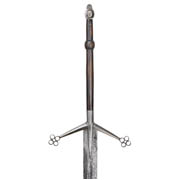
Many of the carved tomb slabs of Highland warriors in the Western Isles show swords of this type. The distinctive shape of the hilt is a development of the medieval Scottish longsword. This is one of the finest surviving examples of an iconic weapon.
- Credit Line/Donor
Bequeathed by R L Scott, 1939
- Collection
R L Scott Collection
- ID Number
E.1939.65.ht
- Location
Kelvingrove Conflict and Consequence