DETAILS
- Discipline
NH: GEOLOGY: FOSSILS
- Scientific Name
Dithyrocaris testudinea (Scouler) 1835
- Common Name
Fossil \ Phyllocarid
- Status
STATUS: Holotype; LABEL STATUS: Figured; ORIGINAL STATUS: Figured
- Place Collected
Scotland, Paisley (about 1 mile east of), ? Gallowhill Quarries (place collected)
- Lithostratigraphy
? Blackbyre Limestone
- Geologic Age
Carboniferous, Visean
- Form
specimen and cast/peel
- Collection
Anderson's University Collection
- Description
-
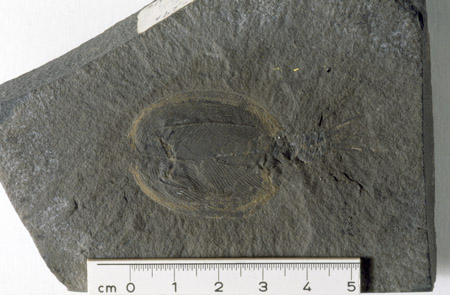
Dithyrocaris testudinea is a phyllocarid or pod-shrimp, a type of crustacean related to shrimps and lobsters. Today’s phyllocarids are marine and have a worldwide distribution. This example is complete and well preserved and is about 6cm long. The shell or carapace is divided into two equal parts. These are roughly oval and the surface has a pattern of closely-spaced, raised lines. The body projects from under the carapace and the tail ends in three spines.
The original description of the locality states that it was collected from a limestone ‘situated about a mile to the east of Paisley. Subsequent research has indicated that the site in question is likely to be Gallowhill Quarries. Here the Blackbyre Limestone, of lower Carboniferous age was worked.
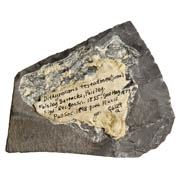
This specimen is the holotype of the species, Dithyrocaris testudinea. It was first described and figured by John Scouler in his paper ‘Account of some fossil Crustacea which occur in the coal formation’ in Records of General Science for 1835. It has been figured in several publications since including the Phyllocarida section of the Treatise for Invertebrate Paleontology, Part R, Arthropoda - ID Number
G.1961.29.a
- Location
In storage
- Terms