Alternate images
Details
- Object type
aquamanile; ewer
- Culture/School
European; German; Jewish
- Place Associated
Germany, Lower Saxony (place of manufacture)
- Date
circa 1300
- Materials
bronze; copper alloy
- Dimensions
overall: 286 mm x 110 mm x 307 mm 3295 g
- Description
-
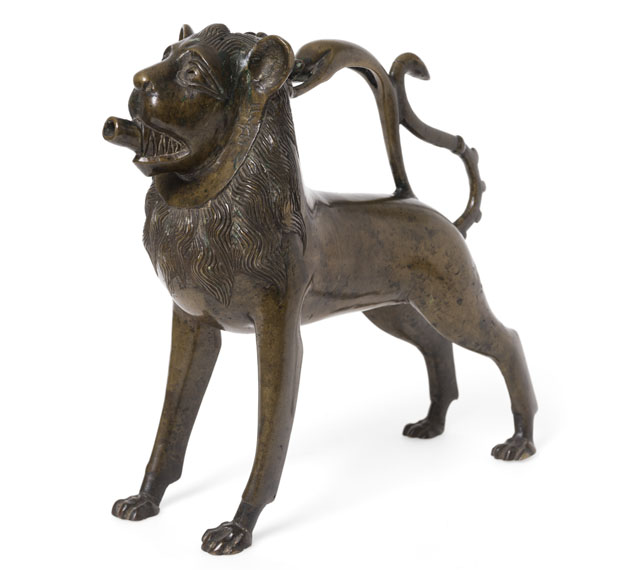
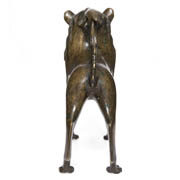
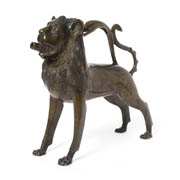
This is a bronze aquamanile (derived from 'aqua' meaning water, and 'manus' meaning hand), a vessel used for holding water, which is poured over a person’s hands to cleanse them for hygienic or ritual purposes. Hand washing was an essential component of medieval religious ritual and secular banqueting.
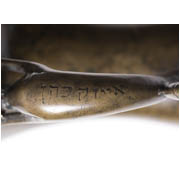
Cast in a range of forms, usually depicting wild animals and fantastical beasts, aquamanile's charming anthropomorphic forms proved especially popular with collectors in the nineteenth and early twentieth centuries, and they were frequently reproduced as well as faked. Burrell fell into the trap of unknowingly acquiring at least one copy. Yet such errors were balanced by spectacular acquisitions such as this wonderful aquamanile in the form of a lion that carries inscriptions in Hebrew. As one of only four known to exist, it is rare evidence of medieval Jewish material culture. In synagogues, as in Christian contexts, aquamaniles were likely used for the ceremonial hand washing of the celebrant, but at least one of the surviving examples is likely to have been used at home to hold the wine used at Kiddush.
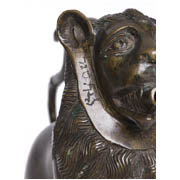
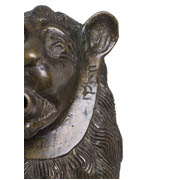
This aquamanile is said to have come from a synagogue in Brilon, Westphalia (see Falke and Meyer, Bronzegeräte des Mittelalters, p.114, no.480), and is inscribed with names in Hebrew characters – ‘Isaac Cohen’ is clear, the other two names are less legible, but possibly read ‘Wolfe’ and ‘Lea (?) Segal’ in two different hands. Across the over 350 medieval aquamanile known to have survived to the present day, this is one of only four known examples to carry Hebrew inscriptions. Other examples can be found at the Metropolitan Museum of Art and the Jewish Museum, New York.
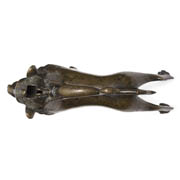
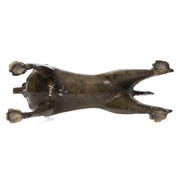
This particular example – one of many made in the form of a lion – is cast from bronze. It was made in Germany (possibly Lower Saxony), probably during the early part of the 14th century. The spout for pouring water is in the lion’s mouth, and there is a hole in his head for filling with water (the lid is lost). His tail, which acts as a handle, turns into a dragon-like animal. William Burrell appears to have used it as a candlestick, as drips of wax were removed from the head and body during conservation in 2018.
Provenance: From the synagogue of Brilon (Germany, Westphalia)[?]; Collection Mortimer F. Schiff, New York; bought by Sir William from the Mortimer F. Schiff sale at Christie’s in 1938 ; given to the City of Glasgow by Sir William and Constance, Lady Burrell, in 1944.
- Credit Line/Donor
Gifted by Sir William and Lady Burrell to the City of Glasgow, 1944
- Collection
Burrell Collection: European Bronzes and Brass Wares [except Statuary]
- ID Number
5-6.9
- Location
Burrell Collection