Details
- Object type
panel
- Title
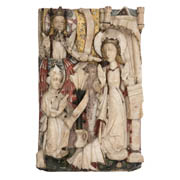
The Annunciation to the Virgin Mary
- Place Associated
England (place of manufacture)
- Date
circa 1450-1500
- Materials
alabaster, polychrome, gilt
- Dimensions
overall: 428 mm x 265 mm 6000 g
- Description
-
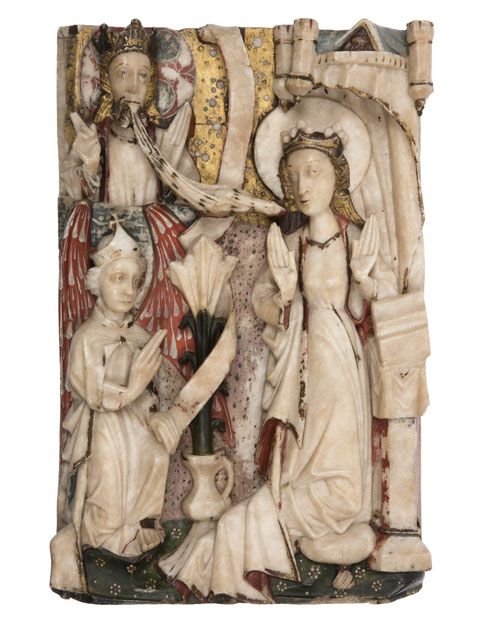
A panel (or table) of carved alabaster depicting the Annunciation. To the right of the panel the crowned and haloed Virgin, wearing a tight-fitting gown and cloak, kneels below a turreted and draped canopy at a prayer desk (prie-dieu), upon which is an open book. She is turned to the left with her hands raised to greet the Archangel Gabriel, who approaches in a kneeling position from the left. The winged Gabriel wears a tiara surmounted by a cross, and an alb, over which is a cloak fastened at the breast with a brooch. He raises his right hand in benediction and holds an unfurled scroll in the left, which winds around a lily standing in a ewer. The bearded figure of God the Father, complete with halo and crown, watches on from the top left corner. His hands are raised in blessing as the Holy Spirit, in the form of a dove, manifests from the hair of his beard and flies towards the Virgin.
Vividly coloured with polychromy and gilding, including the usual ‘daisy’ pattern on the ground level and green on the stem of the lily. Passages of red can be found on the inner folds of the Virgin’s costume, Gabriel’s flecked wings, God the Father’s red and black halo, and in traces on the prayer desk and hem of the canopy. Extensive areas of gilding run along the upper background (originally finished with gesso nodules) and on the hair and crown of God the Father and the Virgin.
Annunciation panels are amongst the more prevalent of alabaster panel survivals, with more than 50 documented to date (see 1.5). It is likely that such panels could serve as both stand-alone devotional aids and as the opening scene in multi-panel altarpieces depicting the ‘Joys of the Virgin’. The Swansea altarpiece, in the Victoria and Albert Museum, London, is one such complete altarpiece with an opening panel of this type.
Nearly all alabaster panels produced in England during this period would have left the workshops painted. Although one fourteenth century record does indicate the painting of a panel in situ after erection within the chapel at Windsor, this appears to be an unconventional case. Surviving documentary evidence suggests that it was common practice for the carvers of the images to also paint both the alabaster panels and their wooden frames and housings. The polychromy and colour palette on this example is typical, with rich green, red, black, brown and shimmering gold gilding, contrasted against the unpainted, translucent white of the alabaster.
It has been suggested that the figure style and dimensions are reminiscent of another panel in the collection (1.8), with both perhaps originating from the same altarpiece. The execution has also been compared with the alabaster tomb of Alice de la Pole, Duchess of Suffolk, at Ewelme, Oxfordshire (c.1470-1480).
- Credit Line/Donor
Gifted by Sir William and Lady Burrell to the City of Glasgow, 1944
- Collection
Burrell Collection: Alabasters
- ID Number
1.4
- Location
Burrell Collection