Details
- Object type
panel
- Title
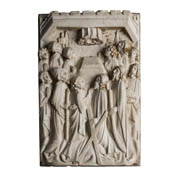
The Ascension of Christ
- Place Associated
England (place of manufacture)
- Date
circa 1400
- Materials
alabaster, polychrome, gilt, lead
- Dimensions
overall: 412 mm x 272 mm
- Description
-
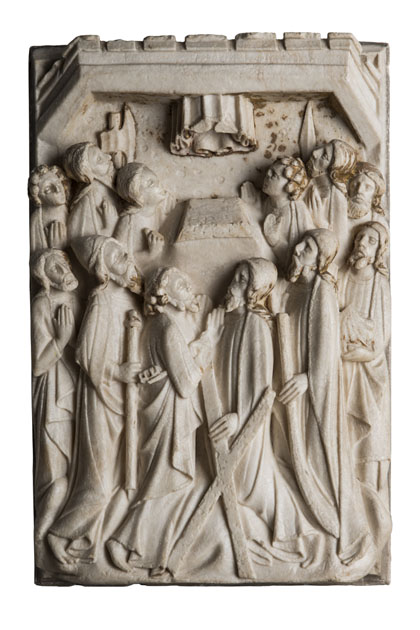
An alabaster panel (or table) depicting The Ascension of Christ. The apostles and the Virgin are kneeling in an arc around a stone or altar set on a mound. Above, represented only by his feet and lower part of robe, Christ is ascending into an embattled canopy enclosed within a chamfered frame. The background was originally decorated with small gesso knobs and finished with gilding, only traces of which remain. Traces of gilt also remain in the recesses within the hair and beards of the figures.
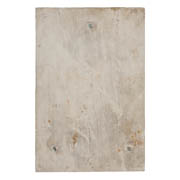
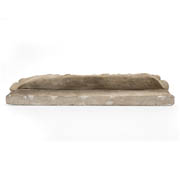
The back of the panel is worked completely flat and drilled with three holes plugged with lead. These holes would originally have been fitted with latten wire for fixing to a wooden frame. This panel is likely to have formed part of an altarpiece representing the Joys of the Virgin. For a complete example of an early fifteenth century ‘Joys of the Virgin’ altarpiece, see the altarpiece from Munkaþverá, Iceland, held at the National Museum of Denmark, Copenhagen.
Representative of the story as recounted by Luke (24:50-53), the attending figures watch on as Christ, having blessed all those in attendance, departs from them and is ‘carried up to heaven’. This example is amongst the finest surviving renderings of the scene and compares well with an example in the Victoria and Albert Museum, London (A.112-1946).
Many of the apostles are identifiable by their attributes, notably St Andrew, with his saltire cross, and the tonsured St Peter, with his key, stand in the centre foreground. They are flanked to the left by St James the Great, wearing a conical hat and pilgrims’ staff, and to the right by St Jude (or St James the Less), holding the fuller’s bat and St Simon, who cradles a scollop shell.
Purchased by Burrell from the art dealer, Frank Partridge in 1949, this panel is associated with two further panels, both in the Los Angeles County Museum of Art (LACMA), depicting the Nativity and the Resurrection (49.26.9a & 49.26.10). All three panels were presented for sale by a Mrs Corbie at Sotheby’s in 1949. It was at this sale that Frank Partridge acquired the Burrell panel. The two other panels sold to Messrs Mallett, eventually being donated to LACMA in 1949 by William Randolph Hearst. An article of 1955 by the alabaster connoisseur and collector, W. L. Hildburgh, supposed that all three panels were once in the collection of the Duke of Norfolk at Arundel Castle, West Sussex.
Catalogues for the Musée des Monuments français, Paris, dating from 1800-1816 (see Musée des Monuments français I, Paris, 1800, pl. 38), show these three panels together in the collection assembled by Alexandre Lenoir, founder of the Musée des Monuments français in 1795. All three are said to have been purchased in 1797 from citizen Boureleau and were understood to have come from the abbey of Marolles (Maroilles), Maroilles, Nord, northern France. The abbey was suppressed during the French Revolution, sacked in 1789, and stripped between 1791-1794; when the site was used as a quarry. Presumably the panels were removed from the abbey at this time, possibly from within an altar.
The Musée des Monuments français closed in 1816 following with the Bourbon Restoration. Many objects were reinstalled where possible, or transferred to other institutions, notably Versailles, the Louvre, and the Musée de Cluny.
- Credit Line/Donor
Gifted by Sir William and Lady Burrell to the City of Glasgow, 1944
- Collection
Burrell Collection: Alabasters
- ID Number
1.18
- Location
St Mungo Museum Gallery of Religious Life