Details
- Object type
ceiling
- Title
Bridgwater Ceiling
- Place Associated
England, Somerset, Bridgwater (place associated)
- Date
15th century
- Materials
wood, oak
- Description
-
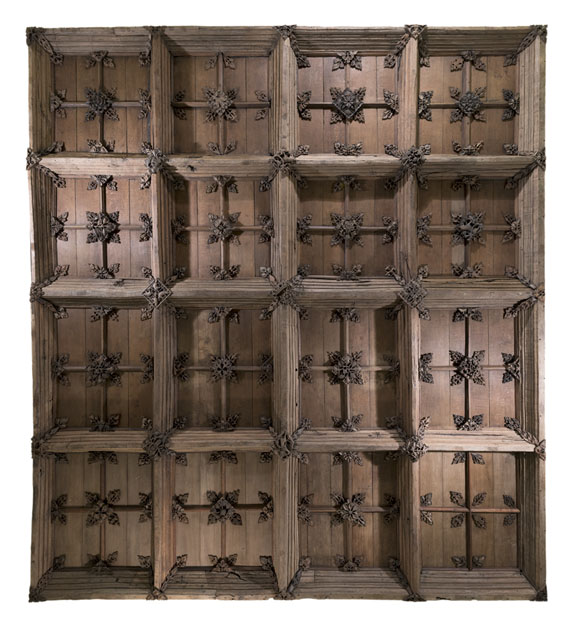
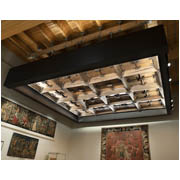
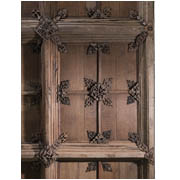
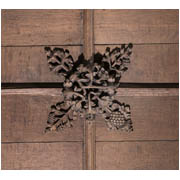
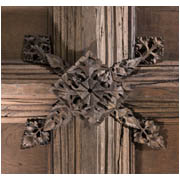
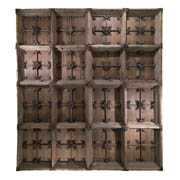
The Bridgwater Ceiling, a 15th century Gothic ceiling from Bridgwater in Somerset. Of timber construction throughout, the ceiling is divided into sixteen panels by ten massively moulded beams. Each panel is made of oak planks and divided into quarters by delicate ribs. Elaborate bosses and other decorative carvings are mounted on the beams and panels. Many of the bosses are carved with ecclesiastical subjects intermingling with carved and pierced vine leaves.
The ceiling is understood to have been discovered in the late 1800s, in a now demolished building at St Mary Street, Bridgwater. It was said to have been found by the then owner of the premises, Robert Pitman (1857-1935), hidden behind ceiling plaster. The discovery of the ceiling can be dated to between 1871-1894, the date at which Mr Pitman bought the St Mary Street property, and the first datable reference to the ceiling made by C. R. B. Barrett. Barrett records a viewing of the ‘remarkable ceiling’ in Pitman’s ‘refreshment rooms’ in his 'Somersetshire: Highways, Byways and Waterways' (1894), where a brief description is supplemented by sketches of two of the bosses.
References to the ceiling in the Auton Courier and Western Advertiser, confirm that it was still in place in 1924. Having failed to secure a sale to the Victoria and Albert Museum, Pitman eventually sold the ceiling in the late 1920s to the American newspaper tycoon, William Randolph Hearst. Upon the removal of the ceiling the St Mary Street premises became structurally weak and was sold to the council and demolished in 1932.
Under Hearst’s ownership, the ceiling remained fragmented across various locations, with some portions seemingly lost prior to the ceiling’s sale to Sir William Burrell, via the agents Murray Adams-Acton, in 1952. Alongside the ceiling, Hearst purchased an ornate gothic medieval screen also uncovered by Pitman at the St Mary Street address. Unlike the ceiling, the screen was installed in one of Hearst’s premises, and remains today in the banqueting hall of St Donat’s Castle, Wales.
Neither the screen, nor the ceiling, which appear ecclesiastical in nature, are considered original to the St Mary Street building. The original source of the ceiling and screen are debated and there are various local foundations that may be considered, including the now lost Franciscan Friary, the Hospital of St John, the Chapel of St Mark in Bridgwater Castle, or perhaps a side chapel of the nearby St Mary’s Church, situated across the road from where the ceiling was discovered.
- Credit Line/Donor
Gifted by Sir William and Lady Burrell to the City of Glasgow, 1944
- Collection
Burrell Collection: Panelling
- ID Number
32.4
- Location
Burrell Collection East Galleries