Alternate images
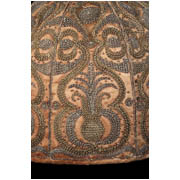
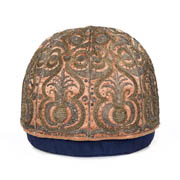
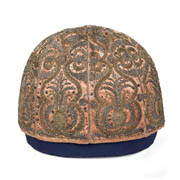
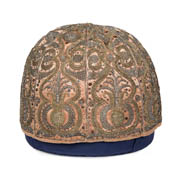
Details
- Object type
cap; nightcap
- Place Associated
England (place of manufacture); England, Gloucestershire, Alveston (place of association)
- Date
circa 1640-1645
- Materials
silk, silver, silver gilt
- Dimensions
overall: 180 mm x 210 mm x 210 mm
- Description
-
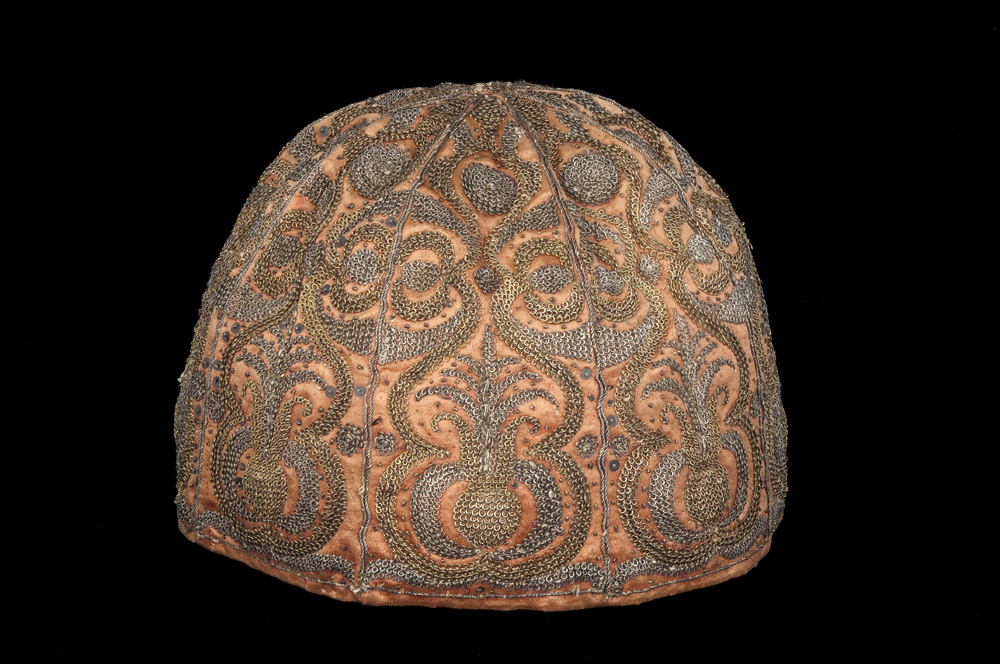
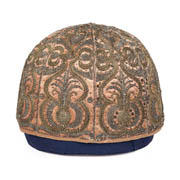
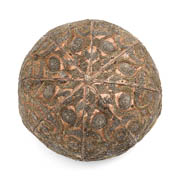
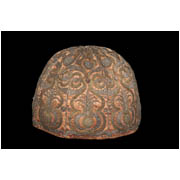
Man's cap or nightcap, to match shoes (29.144-145) in pink silk satin embroidered in silk, silver and silver-gilt threads worked in looped and couched threads and decorated with small and tiny spangles with a stylized pineapple design. Cut in eight conical panels each bordered with a twisted silver thread with the pattern duplicated on each. Lined with yellow silk.
It was fashionable for wealthy gentlemen in the 1600s to wear a form of undress, known as dishabille, at home. This often consisted of a loose gown, nightcap and slippers. One matching set from the early 1600s in Italian purple silk damask decorated with silver-gilt braid survives in the Verney Collection at Claydon House, Buckinghamshire (National Trust). According to seventeenth-century etiquette ladies and gentleman wore dishabille in private at home and dressed in such could only have visitors who were close personal friends of an equal or lesser rank, or trades people. When entertaining guests of a higher social standing the host family were required to wear formal dress. According to this tradition quilted nightcaps should only have been worn by gentlemen at home in the privacy of their parlour or later in the century in their cabinet, the precursor of a library or study. The embroidery design includes what appears to a stylized pineapples. The fruit, which is indigenous to South America, was first introduced to Europe from Guadeloupe by Christopher Columbus in 1493.
A handwritten note previously attached to an accompanying waistcoat (29.128) states that ‘This coat with cap & slippers belonged to Charles II when Prince of Wales and came into the possession of Colonel Thomas Veel of Alverstone near Bristol and Simons Hall, Wotton under Edge when the Prince was sent in 1645, at the age of 15, to command the Western forces of Charles I at Bristol. The coat passed into the Cooper family on the failure of the male line of Veel through Mary Veel who married John Cooper of Wotton-under-Edge in 1790.’ Charles, Prince of Wales, later Charles II (1630–85), first accompanied his father, Charles I (1600–49), during the Wars of the Three Kingdoms at the Battle of Edgehill on 23 October 1642. Three years later, aged only fifteen, Charles was made titular General of the Western Association. He and his army left Oxford on 4 March 1645 accompanied by Lord Arthur Capel (1608–49) and Sir Ralph Hopton (1596–1652), initially staying in Bridgwater and later in Bristol. They were defeated by General Thomas Fairfax (1612–71) and the New Model Army at the Battle of Langport on 10 July, who later stormed Bristol on 10 September.
Another nightcap from the same workshop but embroidered with a different design survives in a private collection.
Provenance: Possibly Charles, Prince of Wales, later Charles II (1630–85); by whom said to have been given to Thomas Veel (1591–1663), 1645; by descent to Mary Veel, who married John Cooper in 1790; Frank Partridge & Sons, London; from whom purchased by Sir William Burrell on 6 August 1937 for £125 (with 29.128 and 29.144-145).
- Credit Line/Donor
Gifted by Sir William and Lady Burrell to the City of Glasgow, 1944
- Collection
Burrell Collection: British Embroideries
- ID Number
29.133
- Location
In storage
- Related People
Frank Partridge & Sons dealer