Details
- Object type
book cover
- Place Associated
France, Limoges (place of manufacture)
- Date
late 12th to 13th century
- Materials
champleve enamel, copper
- Dimensions
overall: 169 mm x 112 mm x 5 mm 352 g
- Description
-
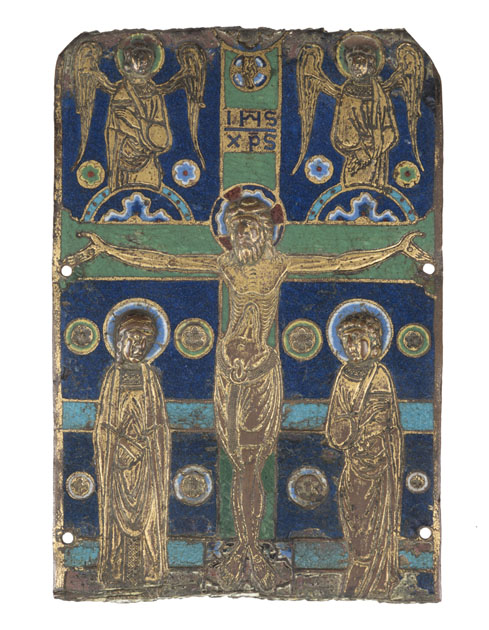
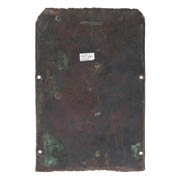
A Limoges enamel book cover, comprising of a copper alloy plate decorated with champlevé enamel, in midnight and lapis blue, turquoise, green, red and white, finished with engraving and appliqué additions. These additions are held by rivets which can be viewed from the reverse, along with a cross roughly punched into the upper field.
The panel is roughly cut along the top and bottom edges, with the upper corners cut-away, suggesting it has been re-sized, possibly to cover a smaller book than originally intended. Four holes along the left and right edge would have allowed for mounting to a wooden board and frame (not present) to complete the book cover.
The panel is dominated by the central figure of the haloed and crucified Christ, who hangs from a green cross, dividing the panel into four sections. Above his head is the inscribed Christogram, ‘IHS XPS’. In the lower registers, the cross is flanked by the grieving figures of the Virgin and St John the Evangelist, both of whom have blue haloes. The upper registers contain two robed and winged angels, both with green haloes and set above a motif of waves, or clouds, surmounted by an arch. The background is finished with two horizontal turquoise bands along the lower half, and a series of rosettes. All five figures are engraved, with traces of gilt and appliqué heads.
The composition of this piece is similar to numerous survivals, including examples at the Musee du Louvre, Paris (OA 6173) and the Ashmoleon Museum, Oxford (AN1887.2394). Originally produced in pairs, alongside depictions of ‘Christ in Majesty’, as seen in the rare surviving pair in the collection of the Musee des Beaux-Arts, Lyons, (D. 283-284), book covers were made in great numbers by the Limoges workshops from the second half of the twelfth century.
The champlevé enamel technique was neither new, nor unique to the workshops of Limoges in southwest-central France. Centres of production existed throughout medieval Europe, including the Rhine and Meuse valleys, Conques, in southern France, and Silos in Spain. However, from the late twelfth century, Limoges produced a range and quanity of enamalled goods unsurpassed by these other centres.
Limoges enamels offered a suitably ornate material with which to adorn and embellish liturgical goods and sacred texts. The lustrous finish of the gilt copper and glass enamel shone like gold and jewels, but traded at a fraction of the price. Enamelled goods were not only prized for their beauty, but also for their sturdiness and durability which was essential for objects that required significant handling, such as book covers and reliquary caskets.
Provenance: Purchased by Sir William Burrell via John Hunt, 29 July 1935, for £150. Possibly previously in the collection of M. T. Schiff; sold Hôtel Drouot, sale no. 6, 13-17 March 1905, no.297;
- Credit Line/Donor
Gifted by Sir William and Lady Burrell to the City of Glasgow, 1944
- Collection
Burrell Collection: Limoges, Enamels, Copper-Gilt items, etc
- ID Number
26.1
- Location
In storage