Details
- Object type
cross; crucifix
- Place Associated
France, Limoges (place of manufacture)
- Date
1200-1225
- Materials
champleve enamel, copper
- Dimensions
overall: 278 mm x 184 mm x 18 mm 451 g
- Description
-
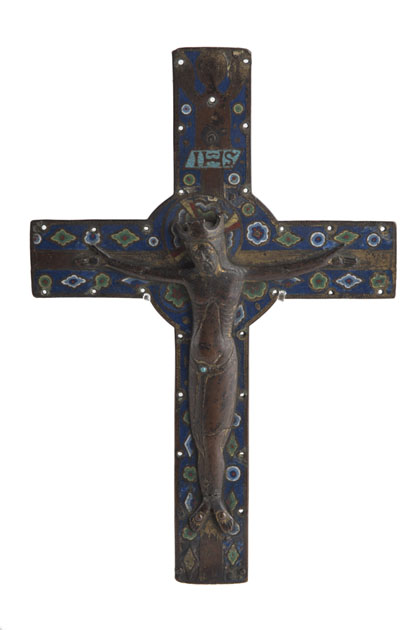
Limoges enamel crucifix of copper alloy, decorated with champlevé enamel, in midnight and lapis blue, turquoise, yellow, green, red and white, finished with engraving, appliqué details and traces of gilt.
The high-relief appliqué corpus of Christ is riveted to the centre of the cross. His arms are slightly bent, and his crowned head droops to his right shoulder. His torso is bare, and the low sitting perizonium is ornamented with a turquoise dot of enamel at the belt line. His head is surrounded by an enamel cruciferous nimbus, finished with radiating lines of red and yellow enamel, above which is the Christogram, ‘IHS’ and the silhouette of an applique angel, now lost. Close parallels exist in the collection of the Archaeological and Historical Society of Charente in Angoulême (2009.0.435), and the Fitzwilliam Museum, Cambridge (M. 331-1904).
This is the central obverse panel only of what would have once been a larger cross. It would have originally been riveted to a core via the holes along the edge, fitted with an enamelled reverse, and finished with decorative caps at the terminals, most likely including representations of Virgin and St John the Evangelist. More complete examples of such crosses can be found St Paul’s Cathedral, Münster, Germany (BM 349), Ärla Parish Church, Sweden, the Victoria and Albert Museum, London (M.575-1910), and the Grand Curtius Museum, Liège, Belgium (J 150).
Such crosses may have had a dual purpose, being used to both ornament the altar of the church and being carried in religious processions. The elaborate decoration that covers the entire surface of the complete examples suggests that these crosses were intended to be seen in the round, rather than the fixed position of the altar.
From the mid-twelfth through to the fourteenth century, specialist metalworkers in Limoges, southwest France, dominated the manufacture and export of champlevé enamelled objects. Champlevé, meaning ‘raised field’, is a technique in which a metal surface is precisely cut-away, creating channels and hollows that are then filled with coloured powdered glass enamels. When fired in a kiln these enamels melt and adhere to the metal, producing a flawless smooth surface, which can be brought to a highly polished finish. The bare metalwork may be further ornamented with additional decorative tooling, gilding and appliqué embellishments. Although fabricated from the relatively inexpensive raw-materials of copper-alloy and glass, the finished products, including book covers, crucifixes, reliquary caskets (chasses), plaques and candlesticks, shone like bejewelled gold, and mirrored the vibrant and colourful design of medieval illumination and stained glass.
Around 8000 known pieces of Limoges champlevé enamel survive to the present day, representing the richest surviving corpus of medieval metalwork. These survivals are found in museums and private collections all over the world and are indicative of the scope and range of products that the workshops produced, and their appeal to both the secular and ecclesiastic markets of medieval Europe. Their great survival is testament to the sturdiness and resilience of Limoges work, which made it such an appealing medium for functional objects that required significant handling, such as book covers and reliquary caskets.
Limoges enamels were present in religious institutions and aristocratic houses throughout Europe, from the shrine of St Peter in Rome to the northern limits of Christendom in Scandinavia. The enamels were sufficiently beautiful and opulent in their appearance to appeal to the very richest of ecclesiastic and secular customers. However, at a fraction of the cost of the gold and jewelled pieces they mimicked, more humble members of the aristocracy and less affluent religious houses could aspire to own such more
- Credit Line/Donor
Gifted by Sir William and Lady Burrell to the City of Glasgow, 1944
- Collection
Burrell Collection: Limoges, Enamels, Copper-Gilt items, etc
- ID Number
26.7
- Location
In storage