Details
- Object type
watercolour
- Title
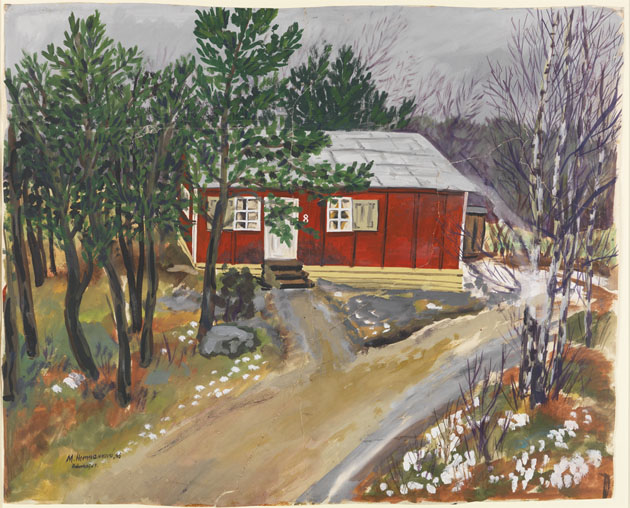
Hut 8 at Robertshöjd 1
- Artist/Maker
Marianne Grant maker
- Culture/School
Czech
- Place Associated
Sweden, Gothenburg (place depicted)
- Date
1946
- Materials
watercolour and bodycolour on paper
- Dimensions
overall: 484 mm x 592 mm
- Description
-
'Most of the refugees here were Hungarian Jewish girls.' - Marianne Grant
After liberation Marianne was registered as a refugee by the Allied Expeditionary Force and given a Displaced Person Record card. This was significant because Marianne was no longer just a number but recognised as an individual. She gave her occupation as ‘artist-painter’. On 10 July 1945 through an Irish volunteer doctor at Bergen-Belsen, Dr Sean Styles, and the efforts of the United Nations Relief and Rehabilitation Administration (UNRRA), which had been set up to repatriate refugees displaced by the war, Marianne and her mother managed to get passage on a Swedish Red Cross boat to Malmö, Sweden. Her mum Anna, who had contracted typhoid, was too weak to make the journey back to Prague as Marianne had hoped. Welcomed in Malmö by members of the Swedish Women’s Voluntary Defence Organisation, Anna was sent to sanatorium to recover while Marianne was initially quarantined in a school before being placed in Robertshöjd 1, a former holiday camp turned refugee camp near Gothenburg, where she was later joined by her mum. Marianne continued to paint.
In November 1945 Marianne wrote to her friend Petr Erben: ‘I live in a small house with two bedrooms. One big, in which 8 girls stay, and one smaller where I live with my mum. It is very simple, iron beds, mattresses filled with wood wool, 2 sheets – you lie on one and cover yourself with the other (that’s the Swedish habit) and also blankets. Also, there are 4 wardrobes, but very narrow, you know like those in swimming pool or tennis court locker rooms. A few little chairs without backrests, table, a huge stove that overheats that little room terribly, and 3 windows. In the corner I paint and some of my pictures always hang there, and it is always messy there (or at least Mum says so, I don’t mind paints and dirty brushes) and it smells of turpentine. I hope you can imagine it all. We eat at a canteen which is quite inconvenient because it rains badly all the time.’ Despite this, there is obvious pleasure expressed in this painting, the red chalet nestles among silver birches and evergreens.
Evacuees were encouraged to work and Marianne initially found ill-paid employment painting ceramics. She and her mother later found an apartment in the city, near the harbour, and Marianne undertook more fulfilling work with a screen-printing company in Alingsås and a cabaret theatre in Liseberg Park in Gothenburg. Although she initially planned to emigrate to Israel, Marianne came to appreciate the quality of life in Sweden. They settled in a small flat just outside the city and established her own design studio, employing a small number of staff.
- Credit Line/Donor
The Marianne Grant Holocaust artworks collection was purchased in 2004 with grant aid assistance from The Heritage Lottery Fund, The National Art Collections Fund and the National Fund for Acquisitions.
- Collection
Marianne Grant Holocaust Artworks Collection
- ID Number
PP.2005.38.42
- Location
In storage