Details
- Name
Marianne Grant
- Brief Biography
1921 - 2007, Czech
- Occupation
Artist
- Description
-
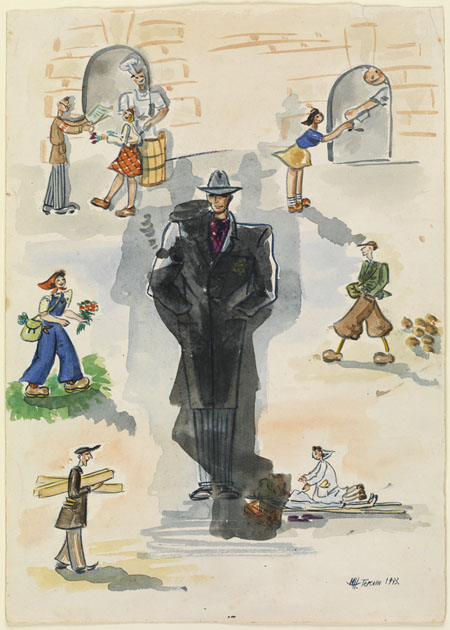
Czech Jewish artist and Holocaust survivor Marianne Grant (née Mariana Hermannová), nicknamed ‘Mausi’, was born in Prague on 19 September 1921 to banker Rudolf Hermann (c.1888–1938) and milliner Anna Hermann (née Rosner; 1889–1973). Showing a propensity for art, she attended the Studio Rotter school of art and design in Prague from 1937 but was prevented from graduating due to the German occupation of Czechoslovakia in 1939. Marianne and her mother were forcibly moved out of their spacious, modern apartment in the fashionable Stromovka Park neighbourhood to a smaller flat in a poorer area. They made unsuccessful attempts to apply for a visa to flee overseas. As Jews they went on to suffer a series of restrictions on their day-to-day lives imposed by the Nazis, including a curfew, segregation on transport and in hospitals, exclusion from certain professional practices, restaurants, cultural venues and sport facilities. As part of her Hachshara, Marianne spent the summer of 1941 working with the Zionist Youth Movement EL AL, of which she had been a member since 1938, on farms in Bohemia and Moravia. From September 1941, like all Jews, she was forced to wear a yellow star badge to publicly signify her Jewish status.
In April 1942 Marianne and her mother were deported to Theresienstadt concentration camp-ghetto, where Marianne worked as a supervisor in the Youth Garden. On 15 December 1943 Marianne’s mother was selected for transport east to Auschwitz-Birkenau, and Marianne followed her. In the Familienlager (Family Camp) she worked as an unofficial teacher in the Children’s Block and was also forced to draw for the infamous Nazi doctor Josef Mengele. In July 1944 Marianne and her mother were sent to Neuengamme concentration camp near Hamburg. They undertook heavy manual work for Hamburg’s oil refineries and on building sites in three of its female satellite camps, Dessauer Ufer, Neugraben and Tiefstack. On 5 April 1945 they were moved by train and on foot to Bergen-Belsen concentration camp, where they were shocked to find thousands of dead and dying prisoners. They witnessed the camp’s liberation by the British 10 days later.
In July 1945 Marianne and her mother managed to get on a Swedish Red Cross boat to Malmö, initially staying in a refugee camp near Gothenburg before finding accommodation and design work in the city. In 1951 Marianne married Jack Grant (1921-1986), a German refugee living in Glasgow. They settled first in Battlefield and then Newton Mearns, where Jack became the minister in the local synagogue. Marianne took evening classes at Glasgow School of Art in 1953-54 (reg. no. 1659) but gave that up in order to focus on being a wife and a mother. They had three children: Susan (b.1952) and twins Geraldine and Garry (b.1957).
Marianne’s remarkable collection of artworks, made within the camps, represents a powerful witness statement of Nazi atrocity in World War II. They were purchased by Glasgow Museums in 2004 with the support of the National Lottery Heritage Fund, Art Fund and National Fund for Acquisitions. In 2002 an exhibition of her artwork was held in Kelvingrove Art Gallery and Museum, before travelling on to the City Art Centre in Edinburgh in 2003, and a book was published to coincide. Marianne was granted Freedom of the City (East Renfrewshire) in 2003 in recognition of her efforts to raise Holocaust awareness. She died on 11 December 2007 at the age of 86. A second book documenting her life and art was published by Glasgow Museums on the centenary of her birth in 2021, dedicated to the 22 members of Marianne’s family who were murdered in the Holocaust.