Details
- Object type
watercolour
- Title
Night After the Battle of Langside
- Artist/Maker
John Lavery artist
- Culture/School
Glasgow Boys
- Place Associated
Scotland (place associated)
- Date
about 1886
- Materials
watercolour on paper
- Dimensions
overall: 380 mm x 460 mm (framed)
- Description
-
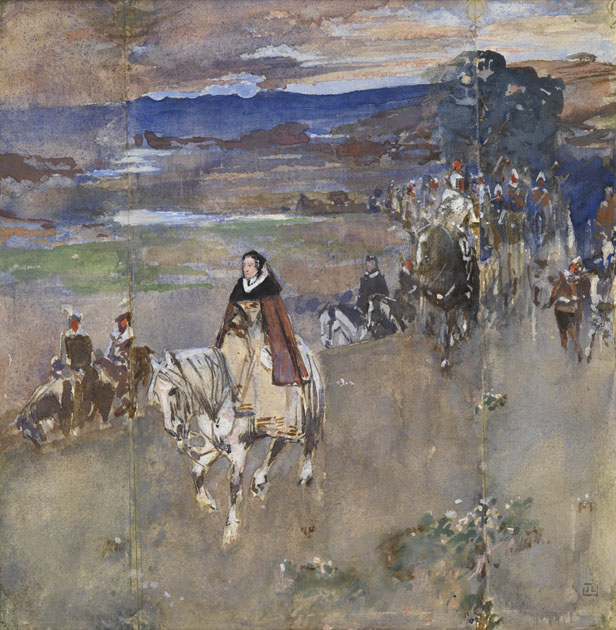
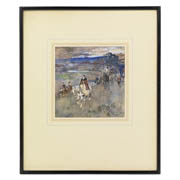
Mary Queen of Scots (1542–1587) flees south through the Ayrshire countryside following defeat at the Battle of Langside (then a village several miles south of Glasgow) on 13 May 1568. The battle, which took place after Mary’s forced abdication, was fought against forces loyal to her infant son James VI led by James Stewart, 1st Earl of Moray, who was acting Regent. It was a battle of great significance in Scottish history. Defeated, Mary abandoned plans to seek refuge in Dumbarton Castle and instead turned south to Dundrennan Abbey in Galloway. Crossing the border to England, she faced imprisonment and ultimately execution. Riding side-saddle, she holds her head high, in contrast to her weary white horse. The remains of her army follow. The colours are muted, with the exception of Mary’s white dress and red cloak which allude to her innocence and impending martyrdom, and the blue of the distant hills which poignantly she will not see again.
This watercolour by Glasgow Boy painter John Lavery is a preparatory study for a larger work, Night after the Battle of Langside (c.1886–93), in the collection of the Belgian government in Brussels, one of two oil paintings of Mary after her defeat at Langside. The other, Dawn, 14th May 1568 (c.1883–87) is in a private collection. Lavery’s biographer Walter Shaw-Sparrow describes the artist from 1884 as ‘devoted to a heroine of Anglo-Scotch history, Mary the Mysterious’. Lavery himself wrote: ‘I am not particularly fond of history and have seldom been inspired by the past. […] Yet from the first day I held a paint-brush my mind was made up to paint a great picture of the Scottish Queen, and I spent some years reading up on the subject. […] I took great trouble with the accuracy of this picture, getting hold of genuine period armour.’ He is known to have consulted the library of Glasgow antiquarian Wylie Guild and to have taken advice from Joseph Stevenson, an authority on Mary, Queen of Scots. In September 1888 there appeared an article in The Scottish Art Review by Lavery entitled ‘On a Portrait of Mary Queen of Scots’, analysing 28 portraits of the queen in the Bishop’s Castle at the 1888 International Exhibition in Glasgow; although Lavery later owned up that his friend and fellow Glasgow Boy Robert Macaulay Stevenson was the real author.
There was a comprehensive display of relics relating to Mary, Queen of Scots at the 1888 International Exhibition. Dawn, 14th May 1568 was hung in Gallery No. 3, British Sale Pictures (Oil) (no. 541), with an extract from a letter by Mary Stuart to the Cardinal of Lorraine published in the catalogue: ‘I have suffered injuries, calumnies, captivity, hunger, cold, heat, flying, without knowing whither, fourscore and twelve miles across the country, without once pausing to alight, and then lay on the hard ground, having only sour milk to drink and oatmeal to eat, without bread, passing three nights with the owls.’ The painting was enthusiastically received by critics. As for Night after the Battle of Langside, Macaulay Stevenson called it ‘the soul of Scotland’. When Lavery decided to display it at the Royal Academy in London, he recalls in his biography how Macaulay Stevenson actually jumped on the train beside him and argued the whole journey down that the painting should not be exhibited south of the border. However, it became the centrepiece in Lavery’s one-man show at the Goupil Gallery in London in 1891. It was not so well received at the Glasgow Institute of the Fine Arts in 1892 and ended up being purchased by the Belgian government in 1928. This preparatory study was kept within the extended family until gifted to Glasgow Museums in 2017.
- Credit Line/Donor
Presented, 2017
- ID Number
PR.2017.4
- Location
In storage