Details
- Object type
plate
- Title
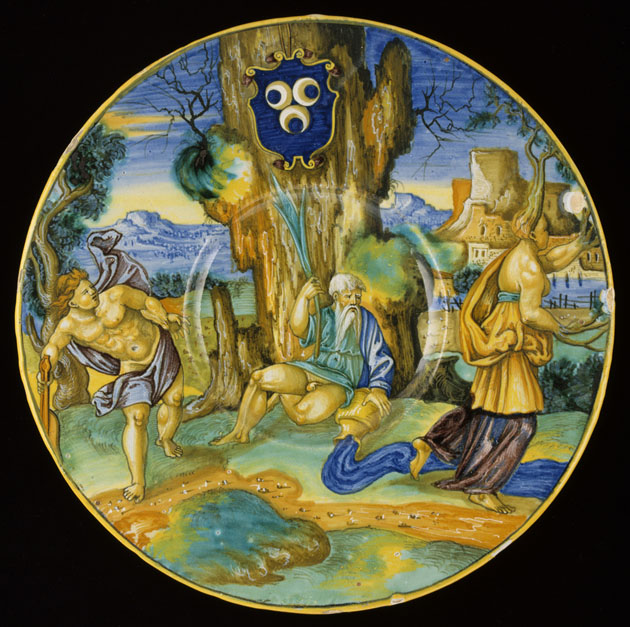
Plate with Apollo and Daphne
- Culture/School
Italian
- Place Associated
Italy, Urbino (place of manufacture)
- Date
circa 1530
- Materials
tin-glazed earthenware; maiolica
- Dimensions
overall: 20 mm x 265 mm 600 g
- Description
-
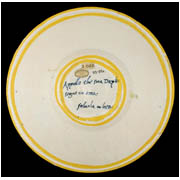
Maiolica plate, vividly coloured with polychrome, depicting a scene from the story of Apollo and Daphne taken from the ancient Roman poet Ovid's book, ‘The Metamorphoses’. In this tale, the beautiful nymph Daphne, daughter of the river god Peneus, is pursued by the Greek god Apollo, who has fallen in love with her. Spurning various suitors for a chased life in the wilderness, exploring and hunting, in emulation of Artemis the goddess of the hunt, Daphne rejects Apollo’s advances as he chases her through the woods. Finally exhausted by Apollo, Daphne arrives at the banks of her father’s waters and begs that he use his powers to change her and strip her of her beauty. At this request, her limbs begin to stiffen as she is turned into a laurel tree. An inscription on the reverse of the plate reads “Appollo che sua Daph' segue et ama. Fabula et hist.” translating as, 'Apollo, who follows and loves his Daphne. Fable and history'
In the painted scene, Apollo, watches on from the left, as Daphne, to the right, sprouts branches from her arms and head. Her father, Peneus, is slumped in the centre of the composition with a sombre look upon his face, as his river pours from a tipped jug in his left hand. He reclines against a tree or rock face, to which is fixed a heraldic device consisting of three crescent moons (azure, three crescents addorsed, argent).
This armorial device connects this plate with the so-called ‘Three Crescents Service’, a series of maiolica wares possibly produced for the noble Strozzi family of Florence. This service is thought to represent one large commission, split between two notable maiolica artists, one anonymous artist known as the ‘Milan Marsyas Painter’, and another, Francesco Xanto Avelli. There pieces can be distinguished by subtleties in their style, and by the arrangement of the heraldic crescents, with Xanto’s pieces showing an arrangement of two crescents over one below, as opposed to the Milan Marsyas Painter’s one crescent over two, perhaps evidence of miscommunication between the two artists. This scene is also duplicated within the service (see The Walters Art Museum, 48.1326), perhaps again, the result of confusion between Xanto and his colleague.
Xanto was one of the most prolific pottery painters working during the Renaissance period. He was born in Rovigo, in the Veneto region of Italy, probably in the late 1480s, and died around 1542. He signed most of his work, and often added other information on the reverse as he has done here – dates, information on his sources, and even extracts from his own poems. His style is characterised by the use of figures extracted from engravings, which usually originated from Raphael’s workshop. He re-composed these figures to create the particular scenes which he had decided to illustrate.
The composition of the figures in this work are based on several engravings and prints. Apollo’s form is similar to that of a spearman on a dish by the same artist in the collection of the British Museum (1851,1201.10), both are derived from an engraving of a Battle Scene by Marco Dente, after Raphael or Giulio Romano. The reclining Peneus is informed by the figure of Uranus, as depicted in another Dente engraving, after Raphael’s, The Birth of Venus, and Daphne is seemingly inspired by an engraving of The Three Muses and the Pierides, by Gian Giacomo Caraglio, after Rosso Fiorentino.
Provenance: Frederic Spitzer Collection. Bought by Glasgow Museums 1893 (lot 1082).
Published:
J.V.G. Mallet, Xanto: Pottery-Painter, Poet, Man of the Italian Renaissance, 2007, p.98, no. 25.
Simon Olding, ‘Italian Maiolica’, Glasgow Museums and Art Galleries, 1982 (No. 46).
- ID Number
1893.93.a
- Location
Out on Loan