Details
- Object type
painting
- Title
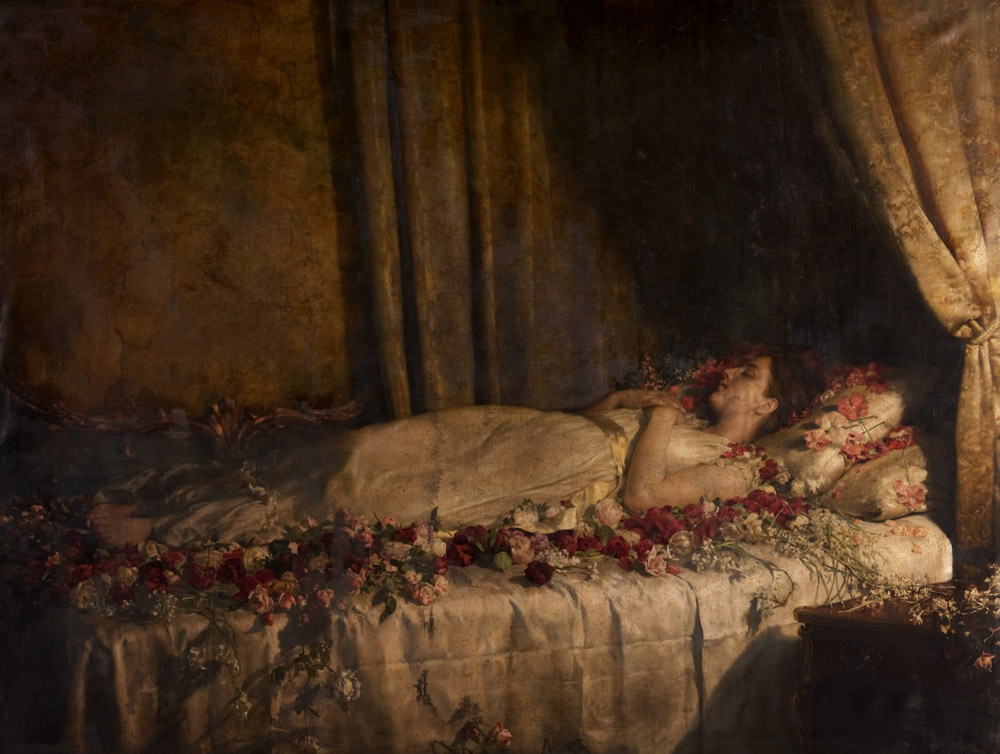
The Death of Albine
- Artist/Maker
John Collier artist
- Culture/School
English
- Date
1895
- Materials
oil on canvas
- Dimensions
unframed: 1372 mm x 1829 mm
- Description
-
This painting is based on the tragic climax of Emile Zola's 1874 anti-clerical novel The Sin of Father Mouret, the fifth novel in the author’s twenty-volume series Les Rougon-Macquart. Set in a small provincial town, Albine, its female protagonist, is an uneducated and fanciful young girl who falls in love with the neurotic Father Mouret. Suffering from amnesia, he consummates a passionate romance with her, but when his memory returns is wracked by guilt and abandons her.
John Collier, a student of Edward Poynter at the Slade School of Art and a disciple of Lawrence Alma-Tadema, was greatly influenced by the Pre-Raphaelites in style and subject matter. A writer as well as a painter, he was known for his humanist ethics and anti-religious views, as expressed in The Religion of an Artist (1926). His ideas were close to those of Thomas Henry Huxley, whose two daughters, Marian and Ethel, he married, and Julian Huxley, his brother-in-law. This painting was exhibited in 1895 at the Royal Academy (no. 589) and was reproduced in the weekly periodical The Graphic on 31 August of that year.
The painting was gifted by the executors of Professor William Smart in 1921. Professor Smart was born in Barrhead on the 10 April 1853 to Alexander Smart and Elizabeth Duncan. At the time of William’s birth, Alexander Smart ran an engineering business at Barrhead, but was shortly afterwards persuaded by his uncle, the founder of John Clark & Co, threadmaker, to join the company, where he became manager and senior partner before his retirement in 1879.
William was educated at East End School and Glasgow High School after which he was employed at the thread mill but he was inclined to enter the church, his grandfather being a clergyman. He did not. He attempted to combine classes at Glasgow University which he entered in 1867 with his commercial career but gave up the studies to concentrate on business and eventually succeeded his father as partner.
In 1876 he married Katharine Stewart Symington, the daughter of the Rev. Dr William Symington and Christian Elder MacRitchie. The Rev. Symington was minister at the Great Hamilton Street reformed Presbyterian church, Glasgow.
In 1879 he became the first president of the Ruskin Society in Glasgow. In 1884 the firm of John Clark & Co. was absorbed in the great 'Thread Combine', the company being sold to an American owner. This left William Smart free to pursue his academic career. He started teaching political economy at Glasgow University.
1886 he lectured in political economy at Queen Margaret College. Together with his wife he helped to run Toynbee House, the Glasgow branch of Toynbee Hall and organized evening classes there.
Smart was preoccupied with the moral dimension of economics and retained a close concern with social welfare and civic problems while avoiding party politics. His major interest was in housing reform and he served on a number of boards and committees dealing with this. During his academic career he published a number of works on political economy.
He died at his home, Nunholm in Dowanhill Gardens, Glasgow, survived by his wife and daughter Christina. The value of his estate was £11,260 – 17s – 11d.
- Credit Line/Donor
Gifted by the executors of Professor William Smart, 1921
- ID Number
1501
- Location
In storage