Details
- Object type
cap; coif
- Place Associated
England (place of manufacture)
- Date
circa 1610-1620
- Materials
linen, silk, silver-gilt
- Dimensions
overall: 240 mm x 435 mm
- Description
-
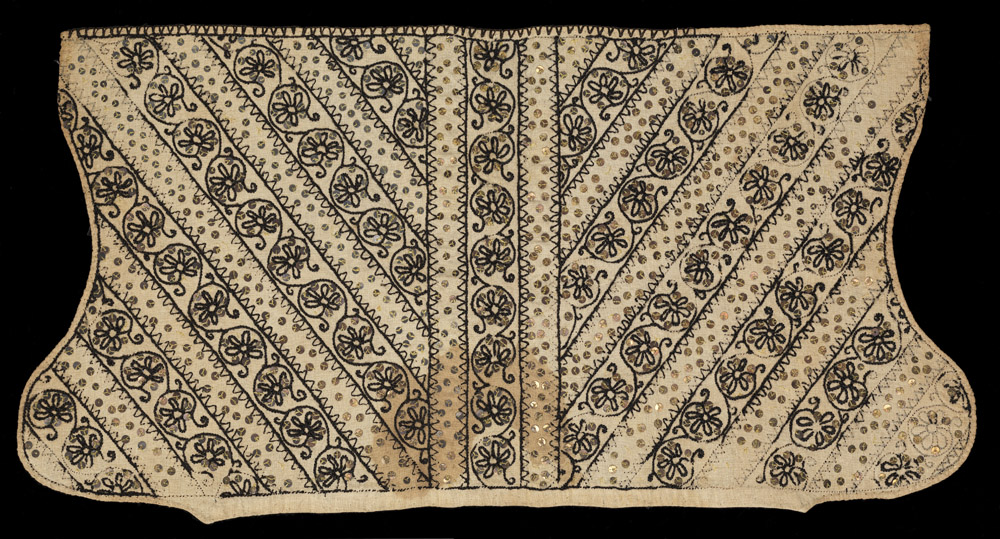
Woman's coif in plain-weave linen (approximately 34 threads per centimetre) embroidered in blackwork in black silk thread worked in stem, outline and double-running stitch decorated with silver spangles with three rows down the centre and diagonal rows either-side alternating between thin coiling stems ending in daisy-type five-petalled flowers with silver and silver-gilt spangles within the scrolls worked in stem and outline stitch (25mm wide) and bands with zig-zag borders worked in double-running stitch and scattered spangles (17.5mm wide in the centre, 23mm wide in the diagonal bands). Where the black silk thread has disintegrated the drawn design can be seen below. Top edge hemmed with a decorative edge, with sides hemmed with black stitch line around edge of design. Un-worked band along the bottom edge turned up to form casing for a drawstring.
Coifs, a kind of close-fitting cap, were worn informally at home by women in all levels of society during the 1500s and early-to-mid 1600s. For the majority of the reign of Elizabeth I (1533–1603) white linen coifs were favoured, either worn by themselves or under hoods and bonnets. However, in the 1590s to 1620s embroidered linen coifs, such as this example, became fashionable for aristocratic, gentry and wealthy middle-class women to wear at home.
This coif is embroidered with a monochromatic design in black silk thread known as blackwork. Many, but not all, designs were worked with counted stitches and the monochromatic designs were also worked in red, blue or other colours. Blackwork is thought to have originated in North Africa with early surviving examples from Egypt dating to the Mamluk period (1250–1517), including textile fragments in the Yousef Jameel Centre for Islamic and Asian Art, Ashmolean Museum, Oxford (for example EA1993.152). The Umayyad Caliphate introduced the style to Spain where by the late 1400s it had spread from Mudéjar art into court dress. One of the earliest formal portraits depicting its use is Juan de Flandes, Isabel of Castille, circa 1500–04 (Palacio Real, Madrid). Isabel's daughter, Catherine of Aragon (1485–1536), is said to have introduced the style to England when she married Arthur Tudor (1486–1502), Prince of Wales, son of Henry VII (1457–1509), in 1501. Often referred to in England as Spanish work at this date, it can be seen decorating shifts in several early Tudor court portraits by Hans Holbein the Younger (circa 1497–1543) and his peers. By the late 1600s it was also being used to decorate accessories, main garments and domestic textiles.
Provenance: John Hunt (1900–76); from whom purchased by Sir William Burrell on 8 September 1938 for £18.
- Credit Line/Donor
Gifted by Sir William and Lady Burrell to the City of Glasgow, 1944
- Collection
Burrell Collection: British Embroideries
- ID Number
29.131
- Location
In storage
- Related People